
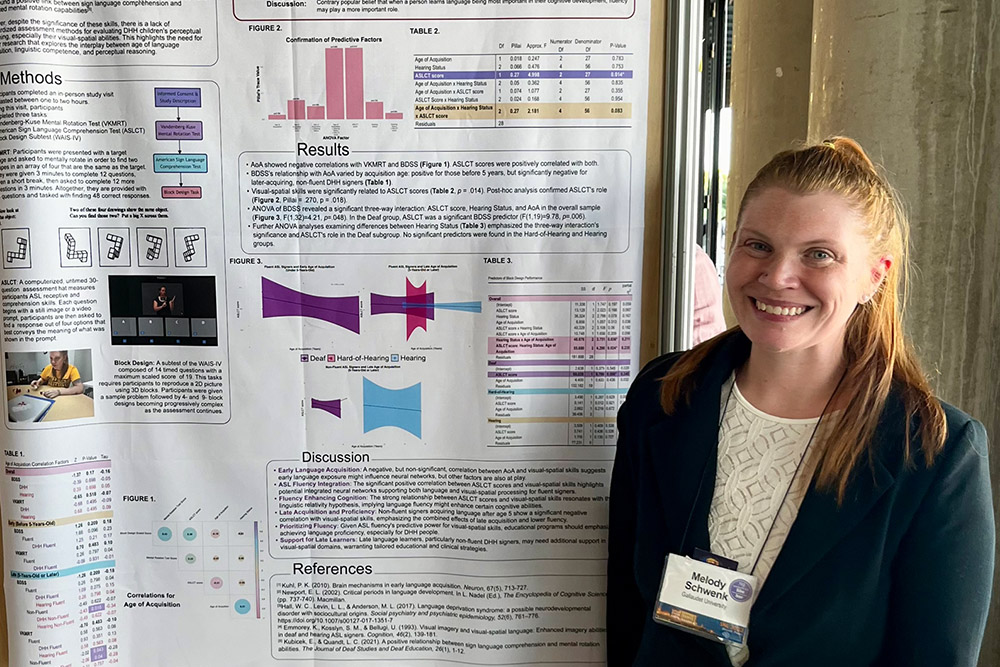
My name is Dr. Melody Schwenk. I earned my Ph.D. in Educational Neuroscience at Gallaudet University. I study spatial cognition and neural plasticity in the Action & Brain Lab. I am primarily interested in how language experiences organize neural networks in the brain. My primary interest is in frontal-parietal coherence to better understand how the brain integrates language and non-linguistic skills.
I am the first person in history to receive both an NIH F31 Predoctoral Fellowship and a National Academy of Education/Spencer Dissertation Fellowship simultaneously.
My dissertation research used 64-channel EEG to examine how deaf and hearing individuals navigate the same spatial tasks. What I found surprised me: both groups achieve identical behavioral performance through opposite neural mechanisms. In other words, the destination is the same but the brain takes a completely different route to get there. This discovery has implications for how we assess cognition in deaf populations, design inclusive STEM curricula, and understand neuroplasticity across the lifespan.
I hold additional degrees from Columbia University (MA, Clinical Psychology), Hunter College (M.S.Ed., Deaf Education), and Stony Brook University (BA, Psychology & Sociology). Before entering research, I worked as a special education teacher and registered behavior therapist. I’ve administered neuropsychological assessments, written IEPs, and worked with autistic children, these anre experiences that continue to shape how I think about translating research into real-world impact.
I am originally from Queens, New York. I am Deaf, bilingual in English and American Sign Language, and also speak French, Spanish, and German. I am a lifelong Mets fan who has made peace with the suffering that entails. I have four dogs — Apollo (a Goldendoodle who believes he is training for a Golden Glove), Nova, Luna, and Hubble — and a cat named Yuki who supervises all of them. In my non-research hours, I crochet, write letters to professional sports teams asking their mascots to join my dissertation committee (some of them said yes), and maintain a strong opinion that #64 is the best jersey number because it represents the number of electrodes in an EEG cap.
If you are interested in my research, my work, or have a mascot who needs a committee appointment, feel free to reach out.